The thorny problem of gorse control
By Jeanette Fitzsimons
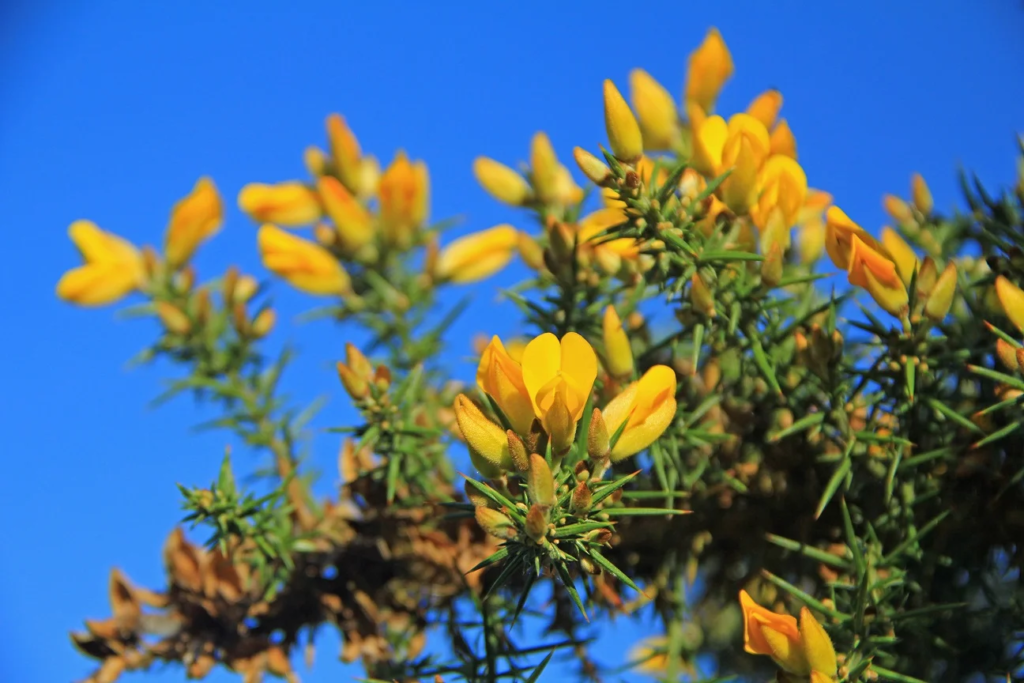
Most of New Zealand’s pastoral hill country is badly infested with gorse. Brought by early settlers from the British Isles to make living fences for stock, in our climate it quickly spread everywhere. A small plant left alone can be a large bush in a year and a few of them can cover a paddock in five years.
It’s not a problem in a market garden or home garden or a cultivated field, where it is simply removed like any other weed. It is manageable in an orchard where the shading helps limit its growth. But in a field of grass it goes rampant.
In an area you are wanting to regenerate with native forest it is positively helpful, adding nitrogen to the soil, shelter and mulch for emerging seedlings, and eventually being shaded out by the growing trees. That’s what we are doing on the 80% of our land that is too steep to farm sustainably. But having given up production on 80%, we want to grow some food on the rest.
Experts differ on whether the seed lasts in the ground for 50 years or 200 but I do know that we won’t be rid of it in my lifetime or my children’s. And fire causes it to germinate vigorously.
I have been given lots of advice over the years on what to do about gorse, most of it totally useless. The only useful suggestion was “if you want to be organic, don’t buy land with gorse on it”. Which does rather call into question our goal of New Zealand being totally organic by 2020!
Some methods we have used include:
1. Chainsaw and fire
Chainsawing down old man gorse gives wonderful firewood and the rest can be stacked and burned – preferably when there is no seed on it. The stumps will regrow – but if you need firewood it is quite a good way to initially clear the land (and maybe follow up with Interceptor, a herbicide based on pine oil).
2. Big machinery
A digger or bulldozer costs, but can rip bushes out by the roots and pile them for burning. It leaves a bit of a moonscape but doesn’t leave roots to grow back so you only have to deal with seedlings.
3. Chemicals
We had tried every non-toxic chemical on stumps before we came to Pakaraka Farm – salt, diesel, caustic soda – nothing worked. And you don’t want them in your soil anyway.
Recently we have tried Interceptor – it’s restricted if your farm is certified organic but permission can be given – to spray on regrowing stumps. Saturate the green shoots when they are about 100–150 mm long and the shoots die. (It kills everything so be careful.) If you can remember to revisit the stumps at the right time, put another application on young shoots each time they reappear and after 3–4 applications the root gives up.
On new land with bad gorse I would recommend cut-and-burn if it is big, then spot-spray a commercial herbicide once on sprouting roots and seedlings to get a really good kill. We agonised over which chemical and opted for metsulphuron which isn’t on any of the lists of things to ban, and doesn’t have a withholding period, but of course still doesn’t comply with organic standards. We took the animals out for about three weeks. This will delay your certification process by a year but give you an easier starting point and you can try to control the seedlings that emerge with grubbing.
4. Animals and other living predators
Yes, goats will eat gorse – when they have eaten everything else in sight (especially all your young trees) and are half starved. Sheep will also nibble the shoots but don’t do much damage. I’ve seen quite effective gorse control on an organic farm in South Otago by electric fencing goats intensively when snow is on the ground. You have to be prepared to sacrifice about 10% of them, and not use does in kid. You will still get seedlings germinating.
There are various weevils, mites and other insects being tried by regional councils. They do weaken the gorse but don’t kill it, and sometimes they actually encourage seed spread.
5. Peasant technology – the grubber
Most of our gorse control has been done by old-fashioned hard work – grubbing. You need to get the thick part at the top of the root out, but the thin long tail won’t regrow. Keep an eye on your wwoofers, as chopping the plants off at ground level makes them twice as vigorous next year. If you do this every year without fail to all the seedlings you will make real progress. When the plants are small and the ground wet it is possible to pull them up by the whole root, which is immensely satisfying.
6. Advanced peasant technology – the Extractigator
Where this article has been heading is to introduce a new tool which makes grubbing much easier. It’s Canadian, made in strong steel and comes in two sizes which are identical except for the length of the handle, and therefore the weight you have to carry around. We have bought two so two people can work together, the stronger person taking the heavier one and tackling the larger bushes.
With the jaws, grasp the gorse stem just where it comes out of the ground. Then you lever against a plate on the ground and with luck the whole plant pops out. We find you need wet ground – no point in tackling it in a drought. (Other soils may be different.)
Provided the plant has a single stem that allows you to grip it before it branches, you can lever out quite large bushes. The jaws will grab a stem up to 50 mm through, though it isn’t guaranteed to come out without breaking. Sprawling bushes with several stems that run horizontally along the ground are much harder and you need to take a grubber with you and grub around them to get purchase with the jaws.
After a while you get the feel of whether it is going to pull or break. Give it time to let go. It takes a bit of practice and I still need more of that. But I think it is a worthwhile improvement on standard peasant technology.
It also works well to remove other weeds such as woolly nightshade, barberry, privet and broom.
You can see it in use and New Zealand prices at www.extractigator.co.nz.
As well as being a farmer, Jeanette Fitzsimons was the co-leader of the Green Party and patron of Soil & Health. Sadly, she passed away in March 2020.